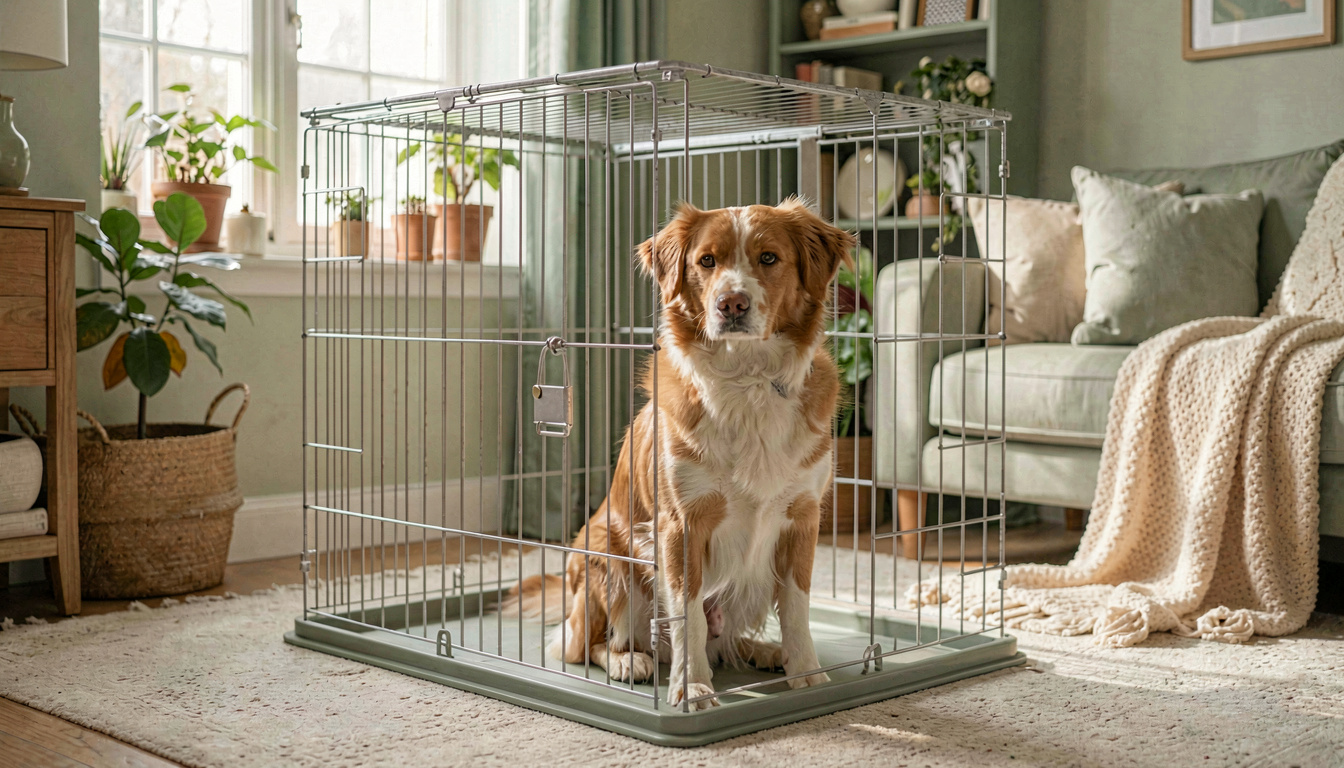
Disclosure: As an Amazon Associate I earn from qualifying purchases. This post may contain affiliate links at no extra cost to you.
What makes separation anxiety different from normal crate whining?
Separation anxiety is a panic response, not a training gap — a dog with separation anxiety is not being stubborn when it screams in the crate; its nervous system is in fight-or-flight mode.
Normal crate whining follows a predictable pattern. The dog fusses for 10 to 20 minutes. Then it settles, curls up, and sleeps.
Separation anxiety looks nothing like that.
The panicking dog escalates instead of settling. It drools through the crate tray. It claws at the door until its nails bleed. It urinates or defecates despite being fully house-trained. It may even bend crate bars or chew through a plastic tray.
The describes separation anxiety as distress behavior triggered specifically by being left alone or separated from a bonded person. That’s the key distinction: the trigger is your absence, not the crate itself.
Here’s the thing. If you may ease separation anxiety like ordinary crate whining, you’ll make it worse. The standard “let them cry it out” advice floods an already panicking dog and deepens the fear response.
That’s the mistake nearly every owner makes. I’ll cover why it backfires in the Common Mistakes section.
“A dog with separation anxiety is not choosing to panic. It is in a state of acute distress — the same physiological state a person experiences during a panic attack.”
How do I start crate training a dog with separation anxiety?
Start crate training by teaching your dog that the crate is a place where good things happen — before you ever close the door, before you ever leave the room, and before the dog ever feels trapped.
The first 3 to 5 days involve zero door-closing. Zero. You’re building an emotional association, not teaching a command.
Why does the crate itself have to feel safe first?
A dog with separation anxiety already has a nervous system that overreacts to being alone. If the first meaningful crate experience is a closed door and your retreating back, the crate becomes a second trigger. Now the dog fears two things: being alone and being crated.
You want the opposite. You want the crate to smell like you. You want feedings to happen near it. You want the dog to walk in voluntarily and find a jackpot reward waiting.
Start by feeding every meal just outside the crate door. Then move the bowl just inside, with the door propped open. Then toss a handful of high-value treats — freeze-dried liver, small cheese cubes — to the back of the crate so your dog steps all the way in. Do this three to five times a day for three to five days.
What size crate does an anxious large-breed dog actually need?
The crate must be big enough for your dog to stand, turn around, and lie flat without pressing against the sides.
A German Shepherd typically weighs 65 to 90 pounds and needs a 42-inch or 48-inch crate. A Labrador Retriever in the 55-to-80-pound range fits a 36-inch or 42-inch crate. A Golden Retriever needs similar dimensions.
Cramped quarters make anxiety worse. A dog that cannot stretch or shift position feels more trapped, not more secure.
What’s the right gradual desensitization schedule for an anxious dog?
A gradual crate training schedule for separation anxiety moves in tiny increments — seconds become minutes, and minutes become an hour only after your dog stays calm at every stage.
The schedule below assumes your dog has already spent 3 to 5 days building positive associations with the open crate. That part is non-negotiable.
| Stage | What You Do | Only Advance When… |
|---|---|---|
| Days 1-5 | Crate door open, meals inside, treat trails | Dog enters willingly, no hesitation |
| Days 5-10 | Close door 5-30 seconds while you sit beside the crate | No whining, no pawing at door |
| Days 10-15 | Close door, stand up, step 3-5 feet away | Dog stays relaxed, returns to the Kong |
| Days 15-22 | Leave the room for 1-5 minutes | Camera shows calm, no saliva pools |
| Weeks 4-6 | Leave the house for 5-10 minutes, then 20, then 40 | No distress signs on camera, no escape attempts |
The schedule is not a race. If your dog panics at any stage, drop back two stages and rebuild. Progress that costs panic is not progress.
But wait — there’s a catch most guides skip. Some dogs never get past door-closing without distress. For those dogs, pushing harder is the wrong move. You step back to alternative confinement, which I’ll cover next.
What alternative confinement options work when crate training backfires?
When crate training worsens separation anxiety — or your dog injures itself trying to escape — step back to alternative confinement options that keep the dog safe without a closed crate door.
A dog that breaks teeth on crate bars or rips out claws is not a candidate for “just a little longer.” That dog needs physical safety and a different training approach.
What’s the safest drop-back option for a panicking dog?
An exercise pen arranged around an open crate. The crate stays open and inviting. The pen gives the dog room to pace, stretch, and self-soothe. Nothing closes. Nothing traps.
This setup preserves your crate training investment while removing the trigger — the closed door.
Does a dog-proofed room actually work for separation anxiety?
For many dogs, yes — and it’s massively underrated. A single room with a baby gate, a comfortable bed, and a frozen Kong gives the dog more agency than a crate. Agency is the antidote to panic.
The room should be bare of hazards: no dangling cords, no medications on nightstands, no shoes within chewing reach. A white noise machine masks outside sounds that trigger barking.
You can also build a bridge plan: dog daycare two days a week, a dog walker for midday breaks, and a friend or neighbor on call. Separation anxiety treatment often includes a management phase while the desensitization work happens.
Why do dogs with arthritis or hip dysplasia need special crate bedding?
Dogs with arthritis or hip dysplasia need orthopedic memory foam crate pads because arthritis causes joint pain, and a hard plastic crate tray makes that pain worse — which sabotages your crate training before it even starts.
Here’s the thing most crate training guides miss entirely. A dog that hurts every time it lies down will never learn to love the crate. The crate becomes a place of physical discomfort, not safety.
How does an orthopedic bed relieve arthritis in a crated dog?
An orthopedic bed relieves arthritis by distributing the dog’s weight across a larger surface area. Memory foam contours to the hips, elbows, and shoulders instead of pressing back against them.
The lists hip dysplasia among the most common orthopedic health concerns for German Shepherds, Golden Retrievers, and Labrador Retrievers. Hip dysplasia is common in all three breeds — and all three are large, heavy dogs that spend meaningful time on the floor.
Now here’s where it gets interesting. A 70-pound Labrador lying on a 1-inch polyfill pad effectively rests on the hard tray underneath. The fill compresses to nothing under that weight. The same dog on 4 inches of high-density memory foam sinks about 1.5 to 2 inches, leaving roughly 2 inches of real cushion between joint and tray.
That’s a measurable difference — and it’s why thickness matters more than brand names.
What should I look for in a crate pad for a large-breed dog?
Look for 3 to 4 inches of CertiPUR-US certified memory foam for dogs over 60 pounds. Smaller dogs can manage 2 to 3 inches. The pad should fit the crate tray snugly so it cannot bunch into a corner and create a hard spot.
The bottom line? If your dog has arthritis or hip dysplasia, the orthopedic crate pad is not an accessory. It’s the foundation of the entire training plan.
What are the most common mistakes owners make when crate training an anxious dog?
The most common mistake in crate training a dog with separation anxiety is closing the door before the dog has ever chosen to rest in the crate on its own.
That single error cascades into everything else. Here are the five mistakes that derail anxious dogs most often.
1. Letting the dog “cry it out.” For a normal dog, a few minutes of fussing is harmless. For a dog with separation anxiety, crying it out is flooding — the panic escalates, the dog exhausts itself, and the crate becomes a trauma trigger.
2. Closing the door too soon. If you rush past the open-door association phase, the dog never forms a positive emotional connection to the crate. You’re training containment, not comfort.
3. Skipping the orthopedic pad for arthritic dogs. A dog with arthritis or hip dysplasia that lies on a hard tray learns that the crate hurts. The identifies hip dysplasia as a hereditary condition in large breeds — and those joints need cushioning, not punishment.
4. Making departures dramatic. Long goodbyes, high-pitched reassurance, and lingering by the door all raise the dog’s arousal right before you leave. Calm, quick departures signal normalcy.
5. Advancing on a calendar instead of on your dog’s behavior. The schedule is a guide, not a deadline. A dog that panics at day 14 but you push to day 15 because “the plan says so” — that’s how regressions happen.
What do veterinary behaviorists say about crate training and separation anxiety?
Veterinary behaviorists consistently describe crate training as one part of a separation anxiety treatment plan — never the whole plan.
The crate works when it becomes a conditioned safe space. It fails when it’s used as a containment tool to “manage” panic.
“Crate training helps separation anxiety when the dog chooses the crate. The moment the crate becomes a place the dog is locked into against its will, the association shifts from safety to threat.”
The same experts note that separation anxiety is treated through a combination of desensitization, environmental management, and — in moderate to severe cases — prescribed medication from a veterinarian. The crate is a tool in the toolbox, not a cure.
Frequently Asked Questions
How long does it take to crate train a dog with separation anxiety?
Most dogs with mild separation anxiety take 4 to 8 weeks of consistent daily work. Moderate cases often take 2 to 4 months, and severe cases can take 6 months or longer with professional support. The timeline depends entirely on how your dog responds at each stage, not on a calendar.
Should I leave the crate door open at night for an anxious dog?
Yes, especially during the first several weeks. An open crate door lets your dog self-soothe by moving between the crate and the room. Forcing overnight confinement early on can undo daytime progress.
What if my dog hurts itself trying to escape the crate?
Stop using a closed crate immediately. Switch to an exercise pen around an open crate or a dog-proofed room with a baby gate. Contact a veterinary behaviorist for a medication evaluation and a professionally supervised desensitization plan.
Does an orthopedic memory foam crate pad help with separation anxiety?
Indirectly, yes. A dog with arthritis or hip dysplasia that lies on a thick memory foam pad is physically comfortable, which removes a major barrier to crate acceptance. A hard tray creates pain that the dog associates with the crate itself.
Can I leave my anxious dog in the crate while I’m at work?
Not until your dog has successfully handled 30 to 60 minutes of calm alone time on camera — then you can build upward slowly. Jumping from 10 minutes to 8 hours is a recipe for regression. Use daycare, a walker, or a friend to bridge the gap during the training phase.
What if my dog has severe arthritis — should I skip the crate entirely?
Not necessarily. Dogs with arthritis or hip dysplasia often benefit from a crate with an orthopedic memory foam pad, because the crate becomes a comfortable, low-traffic resting spot. Just ensure the pad is at least 3 to 4 inches thick for large breeds like German Shepherds, Golden Retrievers, and Labrador Retrievers.
Related Articles
- Best Orthopedic Dog Beds for Arthritis and Joint Pain
- Best Bolster Dog Beds for Anxious Dogs That Need to Nest
- Best Large Breed Dog Beds for German Shepherds and Labs
- Best Crate Pads and Mats for Comfortable Confinement
- Best Memory Foam Dog Beds for Hip and Elbow Support
What This Gear Does Not Do Well
However, crate training a dog with separation anxiety can backfire because confinement often amplifies panic rather than creating safety; a dog that frantically claws, bites, or tries to escape the crate risks dental injuries, torn nails, and deepening the association between being alone and being trapped. The structured desensitization this approach demands is extremely slow and can fall apart on any day the dog must be left longer than planned. Some dogs never accept the crate as a refuge, making alternative confinement the only viable path.
Sources and Further Reading
The guidance in this article draws on published material from the following organizations:
- Walking or running with your dog — American Veterinary Medical Association
Last updated: August 29, 2026
19 thoughts on “How To Crate Train Dog Separation Anxiety”