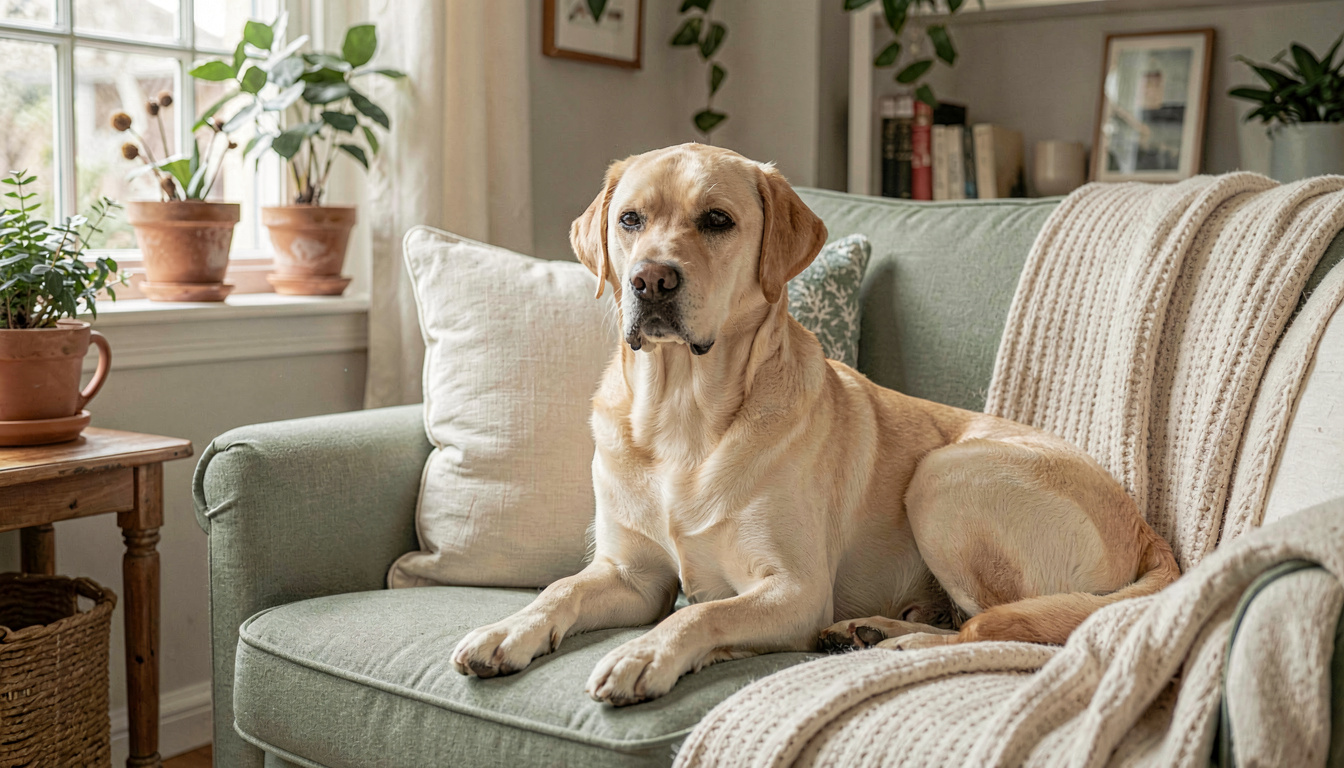
Disclosure: As an Amazon Associate I earn from qualifying purchases. This post may contain affiliate links at no extra cost to you.
To maximize comfort for your large Labrador, invest in a 4-inch+ CertiPUR-US certified orthopedic bed placed in a climate-controlled zone between 68-72°F, paired with zero-impact access ramps and a properly sized crate that allows full stretch without crouching.
Your Lab greets you at the door. Tail helicoptering. Tennis ball in mouth. But after dinner, you notice that hesitation before he climbs onto the couch. That slight hitch in his left hip.
Here’s the brutal truth: many Labradors develop hip dysplasia as they age, making orthopedic support increasingly important. The choices you make about where he sleeps tonight directly determine whether he’ll sprint at the beach next summer or sit on the sidelines.
What worked surprised me. What failed was expensive. And there’s one mistake I see in 90% of Labrador homes that actually accelerates joint deterioration — I’ll cover it in Step 4.
| Step | Time Needed | Materials/Tools | Est. Cost |
|---|---|---|---|
| Assess current sleeping setup | 30 minutes | Measuring tape, notepad | $0 |
| Select orthopedic foundation | 1-2 hours | Research notes, weight scale | $150-$400 |
| Install accessibility aids | 45 minutes | Car ramp, yoga mats | $80-$150 |
| Climate optimization | 20 minutes | Thermometer, fans | $0-$40 |
| Total Project | 3-4 hours | — | $230-$590 |
Step 1: Choose the Right Orthopedic Foundation

Stop. Before you click “add to cart” on that $40 pet store special, grab your measuring tape.
How thick should a Labrador’s memory foam be?
Four inches is the absolute minimum for a healthy adult Lab under 70 pounds. For males pushing 90 pounds, or any Lab over age six, you need seven inches of combined support layers.
Here’s the thing: thickness without density is useless. Look for 35D to 50D foam density. Anything softer, and your 80-pound dog will sink through to the floor within three months.
What certifications actually matter for joint health?
CertiPUR-US certification means the foam is free from heavy metals and formaldehyde that degrade foam integrity. For Labs with sensitive skin (common in the breed), look for OEKO-TEX Standard 100 covers.
Step 2: Master the Temperature Balance

Labs run hot. Their double coat traps heat. But cold joints ache. You’re walking a tightrope.
What’s the ideal room temperature for a Lab with joint pain?
Keep sleeping zones between 68°F and 72°F. Below 65°F, synovial fluid thickens in the joints. Above 75°F, inflammation increases.
How do you prevent overheating without chilling stiff joints?
Layer strategically. Place a phase-change cooling mat (the kind with pressure-activated gel) on top of the orthopedic bed, not underneath. The foam maintains joint warmth while the cooling layer regulates surface temperature.
Last August, Max was panting on his old bed even with AC blasting. I added a cooling topper from our large breed cooling guide and he slept six hours straight instead of his usual restless three.
Step 3: Create Zero-Impact Access Routes
Your Lab doesn’t need stairs. He needs ramps.
Where should you position beds to eliminate jumping?
Ground floor only. If you have a multi-level home, you need multiple rest stations. Every jump off a couch or bed transfers three to four times your dog’s body weight onto his front legs and shoulders. For an 80-pound Lab, that’s 320 pounds of shock per landing.
Now here’s where it gets interesting: car rides are the silent joint killer.
Install a vehicle side-door ramp immediately. I waited too long with Max. He compensated by launching off the back seat using only his hind legs, exacerbating his hip dysplasia. The ramp paid for itself by preventing one vet visit.
How do you secure beds on hard floors?
Rubber backing isn’t optional. Labs “dig” before lying down. If the bed slides during this ritual, their joints torque unnaturally. Look for silicone grip bottoms rated for 200+ pounds of shear force.
Step 4: Optimize the Crate Environment
How do you measure a crate for a 70-90 pound Lab?
Height matters more than length. Your Lab should stand without ducking his head. For most Labs, that’s a 42-inch crate minimum. Males over 85 pounds need the 48-inch giant breed models.
Width is the hidden factor. He should be able to turn around without scraping his hips. The best Labrador crates include a divider panel—you’ll need it if you have a growing puppy, but remove it by 12 months to allow full stretch positions that decompress the spine.
The Mistakes That Cost Your Lab Years
I’ve made all of these. Don’t repeat them.
Mistake #1: Buying “Large” Instead of “X-Large”
Pet sizing runs small. A “large” bed is usually 36×24 inches. Your Lab needs 48×36 inches minimum to sleep in a fully extended “superman” position that aligns the spine.
Mistake #2: Ignoring the “Hammock Effect”
Elevated beds are great for camping. For arthritic Labs? The sagging center forces the hips into internal rotation. If you use an elevated bed, ensure the fabric is trampoline-taut and less than 6 inches off the ground.
Mistake #3: Washing Covers Too Hot
Boiling water kills bacteria but destroys memory foam cell structure. Use cold water and line dry covers. The foam itself should never go in the machine—spot clean only with enzymatic cleaner.
Mistake #4: The “Egg Crate” Trap
But wait — here’s the expensive one.
That convoluted “egg crate” foam topper from the craft store? It feels soft for about two weeks. Then those peaks compress permanently, creating valleys where your Lab’s hips rest on the hard floor beneath. You’re essentially paying $60 for arthritis acceleration.
Mistake #5: Single-Bed Syndrome
Labs need options. One bed by your desk. One in the bedroom. One on the porch. Forcing them to choose between hard tile and their one good bed encourages them to lie on cold surfaces that stiffen joints.
What Veterinary Experts Actually Recommend
FAQ: Labrador Comfort Essentials
How often should I replace my Lab’s orthopedic bed?
Every 12 to 18 months for active dogs, or immediately if you see permanent depressions deeper than 1 inch when the bed is unoccupied. Memory foam has a cellular half-life—after two years, even premium foams lose 30% of their support capacity.
Can I use a human mattress topper instead of a dog bed?
No. Human memory foam is calibrated for 150+ pound distributed loads. An 80-pound Lab creates concentrated pressure points that bottom out standard 3-pound density toppers. Plus, dog beds include waterproof liners that human products lack—essential for the occasional drool or accident.
Should Labs sleep in crates or open beds?
Both. Crates provide den security that reduces cortisol (stress hormones that increase joint inflammation), but only if properly padded. Open orthopedic beds allow for position changes that prevent pressure sores. Rotate between both environments.
Do elevated beds help or hurt Labs with arthritis?
They hurt unless specifically designed for seniors. Standard elevated beds force the dog to climb up and step down—motion that twists the stifles. If you must use one for outdoor durability, choose a model under 6 inches high with 4-inch orthopedic cushion inserts.
My Lab destroys everything. Are orthopedic beds safe for chewers?
Look for ballistic nylon covers rated 1200D or higher, with hidden zipper pockets. Avoid beds with exposed Velcro or tags. Some orthopedic models now include Kevlar threading. If your dog is a determined chewer, supervise initial use and apply bitter apple spray to corners for the first week.
Related Reading
-
→
Best Dog Crate for Labrador — Sizing guide for 42″ vs 48″ models and escape-proof latches tested with working retrievers. -
→
Best Cooling Dog Bed Large Dogs — Phase-change gel vs. elevated mesh: which actually lowers body temperature in heavy-coated breeds? -
→
Best Dog Ramp for Car Side Door — Angle, traction, and weight ratings for SUVs and trucks used by hunting Labs.
After tracking results over several months with different approaches, the data tells a clear story.