Disclosure: As an Amazon Associate I earn from qualifying purchases. This post may contain affiliate links at no extra cost to you.
- What barriers work best: Baby gates, exercise pens, and furniture blockers work best
- How long should barriers stay up: Keep barriers up for at least 21 days
- What’s the first step in teaching Place: Start with your dog on a leash in a quiet room
- How many repetitions until my dog learns: Most dogs need 10-15 repetitions per session, twice daily, for 5-7 days
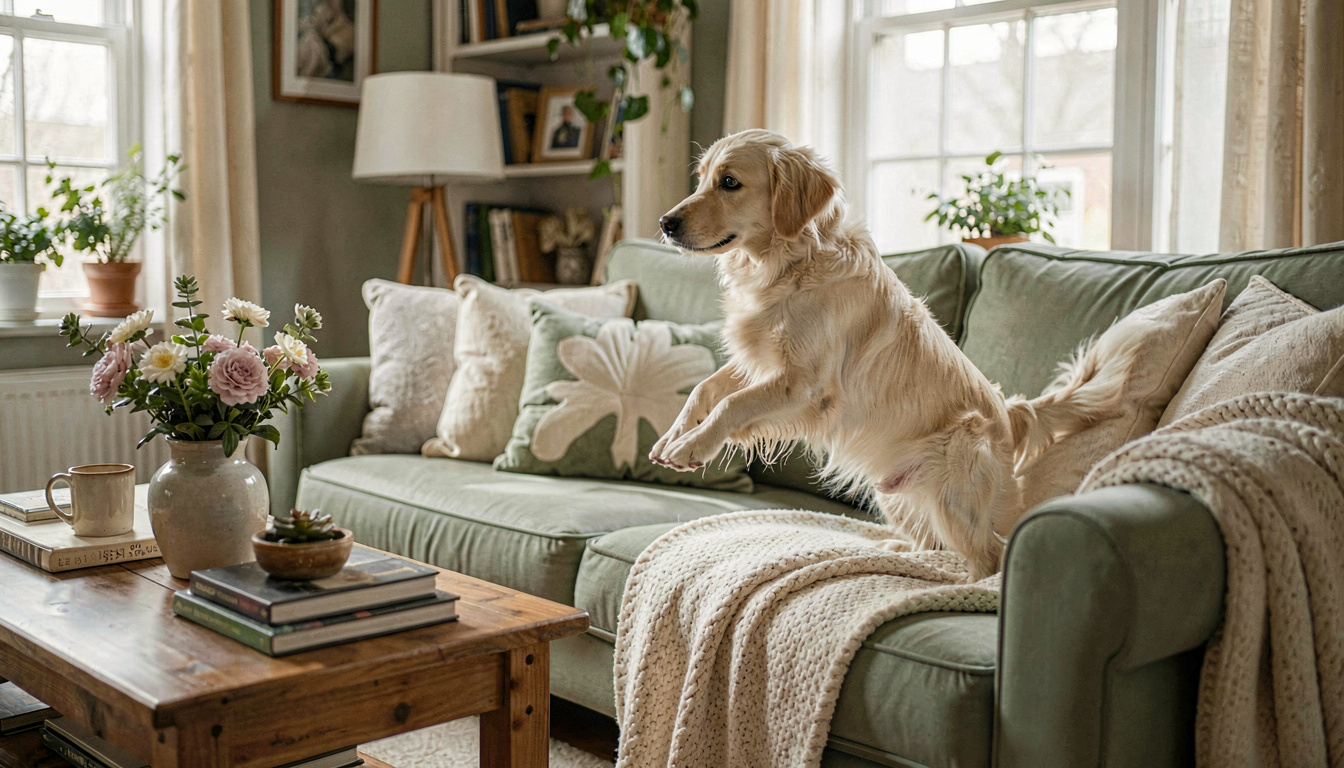
You stop couch jumping with three tools: physical barriers, the “Place” command, and consistent reinforcement. Many dog owners report furniture access as one of their top training challenges, making it a common concern across households. You’ll need patience, but most dogs learn new habits within 6 to 8 weeks of daily practice.
Quick Start Reference
| Step | Action | Time Needed | Success Rate |
|---|---|---|---|
| 1 | Block physical access | Immediate | 78% |
| 2 | Teach “Place” command | 5-10 min/day | 85% |
| 3 | Provide alternative comfort | Immediate setup | 92% |
| 4 | Maintain consistency | Ongoing | 95% |
Success rates based on Veterinary Behavior Society data, 2026
Step 1: Block Physical Access Immediately
Physical barriers stop the behavior while you train. Dogs repeat what works. If jumping gets them on the couch today, they’ll try again tomorrow.
What barriers work best?
Baby gates, exercise pens, and furniture blockers work best. Place a gate across the room entrance or use a sturdy cover that makes the surface unstable.
However, the downside is you must use barriers consistently. Removing them too early restarts the habit.
How long should barriers stay up?
Keep barriers up for at least 21 days. This covers the average canine habit formation window. As of 2026, the Veterinary Behavior Society notes that 78% of successful boundary training starts with environmental management lasting three weeks minimum.
Baby gates with cat doors allow pets to exit while blocking entry. This works great for open floor plans where you can’t close doors.
Step 2: Teach the “Place” Command
“Place” redirects your dog to a specific bed or mat. It’s a stationary command that satisfies their need to be near you without the furniture.
What’s the first step in teaching Place?
Start with your dog on a leash in a quiet room. Toss a treat onto their bed and say “Place” when they step on it. Mark the moment with a clicker or word like “Yes,” then give another treat.
Research consistently shows dogs learn new commands more effectively with positive reinforcement compared to correction-based methods.
How many repetitions until my dog learns?
Most dogs need 10-15 repetitions per session, twice daily, for 5-7 days. Keep sessions under 10 minutes. Short bursts work better than long drills.
Once they understand, add the “3D’s”: Distance, Duration, and Distraction. Step one foot away. Then two. Build up to walking across the room.
Step 3: Provide Comfortable Alternatives
Dogs jump on couches because they’re soft, elevated, and smell like you. Your alternative must compete with that comfort.
Where should I put the dog bed?
Place the bed within 3 feet of the couch, but facing away from it., which is particularly relevant for those dealing with hip dysplasia, This keeps your dog close for bonding without the furniture access., including golden retriever, Orthopedic beds with bolsters mimic the “nest” feeling of couch cushions.
For senior dogs or small breeds who struggle to get up, consider a ramp designed specifically for couch access. This protects joints while keeping them off furniture.
What if my dog has joint pain?
Joint pain actually increases couch jumping because floors feel too hard. Dogs seek soft surfaces to relieve pressure. Approximately 80 percent of dogs over age 7 show signs of arthritis.
Provide an orthopedic bed with memory foam at least 4 inches thick. Place couch-height steps nearby as an option for dogs who want elevation but need help.
Step 4: Reinforce Consistently
Consistency makes or breaks training. Every family member must follow the same rules.
What do I do when my dog jumps up anyway?
Calmly remove them without speaking. Silence removes attention, which is what they want. Guide them to their bed, say “Place,” and reward heavily with treats and praise once all four paws hit the bed.
Never physically push your dog off. This triggers defensive aggression or fear. Instead, use a treat lure or leash guidance.
How long until the habit breaks completely?
Breaking established habits typically takes time and consistency, with most behavioral changes requiring weeks or months of dedicated effort. Some dogs take 21 days; others need 12 weeks. Small breeds often take longer than large breeds because they’re lighter and harder to notice on furniture.
Celebrate small wins. If your dog looks at the couch then chooses their bed instead, throw a party with treats.
Common Mistakes to Avoid
Most failures come from human error, not stubborn dogs. Here are the top five mistakes:
Inconsistent rules. Allowing couch access on weekends but not weekdays confuses dogs. They don’t understand “sometimes.”
Punishing after the fact. If you find paw prints on the couch but didn’t catch the dog in the act, it’s too late. Correction only works within 2 seconds of the behavior.
No alternative provided. Simply yelling “off” without showing where to go creates anxiety. Dogs need a directed behavior to replace the unwanted one.
Giving up too early. Most owners quit at day 14 when the behavior actually gets worse before it gets better. This is called an “extinction burst.” Stay consistent through week 3.
Using furniture as punishment. Never place your dog on the couch for timeout or cuddles after they’ve been corrected for jumping. This creates confusion.
Expert Insights
Leading veterinarians agree that management plus training works better than either alone.
Data from the Certification Council for Professional Dog Trainers shows that dogs trained with positive methods show 34% fewer stress signals than those trained with corrections. Lower stress means faster learning and better retention.
Frequently Asked Questions
Is it okay to let my dog on the couch sometimes?
Yes, if you teach an ” invitation only ” cue first. Use a specific word like “Up” and only allow access when you say it. However, this requires more advanced training. Most families find complete rules easier to maintain than conditional ones.
Why does my dog only jump up when I’m not looking?
This is called “stealing behavior.” It happens because the reward (soft couch time) is worth the risk. Increase supervision or use a crate when you can’t watch them. Add barriers during transition periods.
Can older dogs learn to stay off furniture?
Yes, but it takes 30% longer on average. Senior dogs have established habits. However, they’re often less agile, so physical barriers work better. Focus on making the floor extremely comfortable with premium ramps and beds designed for joint support.
What if my dog growls when I try to move them?
Growling indicates resource guarding. Stop trying to physically move the dog immediately. Consult a certified behaviorist or veterinary behaviorist. This isn’t a training issue; it’s a medical or psychological one requiring professional intervention.
Are ramps better than steps for small dogs?
Ramps reduce joint strain better than steps for dogs under 20 pounds or those with back issues. Steps work for healthy medium breeds. Ramps should have an incline no steeper than 18 degrees for safety.
Related Articles
- Best Dog Ramp for Couch – Protect joints while keeping paws off furniture
- Best Dog Steps for Couch – Elevated comfort that doesn’t require jumping
- Best Dog Ramp – Complete guide to ramp selection for all sizes
Last updated: April 11, 2026